


Today's Current Affairs 5/03/2024
- Smriti IASxp

- Mar 5, 2025
- 5 min read
IE Analysis:
JN Analysis:https://youtu.be/QHFLweJHLyc?si=gL4rRj3ivJEKUKd_
1 .PM-SYM: The Pradhan Mantri Shram Yogi Maandhan (PM-SYM) is a government-sponsored pension scheme in India designed to provide social security to workers in the unorganized sector. It aims to offer a minimum assured pension of ₹3,000 per month after the age of 60, thereby ensuring financial stability during old age for individuals with limited resources.
Eligibility is restricted to those aged between 18 and 40, with a monthly income of ₹15,000 or less, and who are engaged in unorganized labor, excluding those covered by existing social security schemes like EPF, ESIC, or NPS, and income taxpayers.
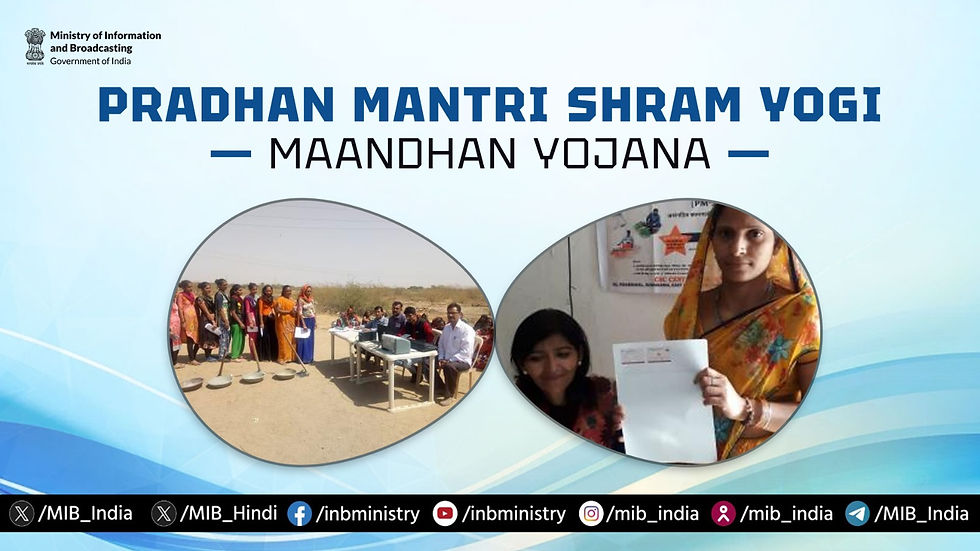
The scheme is voluntary and contributory, with the government matching the worker's contributions, and it also includes a family pension provision for the spouse. Enrollment is facilitated through Common Service Centres (CSCs) and the Maandhan portal, with the overarching goal of providing a crucial safety net for some of the country's most vulnerable workers.
2 . Christian Stocker was sworn in as Austria's new Chancellor on March 3, 2025, leading a three-party coalition government comprising the conservative Austrian People's Party (ÖVP), the center-left Social Democrats (SPÖ), and the liberal Neos.
Austria is a landlocked country in Central Europe, renowned for its rich cultural heritage and stunning Alpine landscapes.
It shares borders with eight countries: Germany, the Czech Republic, Slovakia, Hungary, Slovenia, Italy, Switzerland, and Liechtenstein.
The nation has a profound musical legacy, being the birthplace of classical composers like Wolfgang Amadeus Mozart and Johann Strauss II. The capital city, Vienna, has historically been a hub for classical music, hosting numerous concerts and festivals that continue to attract enthusiasts worldwide.

Austria's diverse geography includes the Eastern Alps, which cover a significant portion of the country, making it a prime destination for winter sports such as skiing and snowboarding.
In terms of environmental initiatives, Austria is recognized for its commitment to sustainability. The country recycles approximately 63% of its waste and generates most of its electricity from renewable energy sources, reflecting its dedication to eco-friendly practices.
3 .India-Belgium Bilateral Relations Belgium established diplomatic relations with India in September 1947, shortly after India's independence. The relationship is rooted in shared values such as the rule of law, federalism, and pluralism. Belgium supports India's bid for a permanent seat on the UN Security Council.
High-Level Visits:
From India:
External Affairs Minister Dr. S. Jaishankar met Belgian counterparts in February 2020 and August 2019, discussing bilateral and regional issues.
Vice President M. Venkaiah Naidu visited Brussels in October 2018 for the Asia-Europe Meeting (ASEM) and met the Belgian King.
Prime Minister Narendra Modi visited Belgium in March 2016, condemning terrorism and signing agreements in biotechnology and shipping.
President Pranab Mukherjee visited Belgium in October 2013, inaugurating the Europalia-India Cultural Festival and signing MoUs between universities.
Other visits include those by the Speaker of the Lok Sabha (2015) and various ministers.
From Belgium:
King Philippe and Queen Mathilde visited India in November 2017, marking 70 years of diplomatic ties. They inaugurated exhibitions, participated in business seminars, and visited cultural sites.
The Belgian Royal family has led economic delegations to India, including visits by Princess Astrid (2013,2025) and King Albert II (2008).
Economic & Commercial Ties:
The India-Belgium-Luxembourg Economic Union (BLEU) Joint Commission Meeting (JCM) oversees economic cooperation. The 17th JCM was held virtually in September 2021.
Bilateral trade reached €8.8 billion (Jan-Sep 2021), with diamonds dominating trade. Belgium is India’s 19th largest investor, with €2.19 million invested from 2000-2020.
Around 160 Belgian companies operate in India, while Indian IT firms like TCS and Infosys have a presence in Belgium.
Sectoral Cooperation:
Science & Technology: Collaboration includes MoUs on space technology, renewable energy, and nuclear research. A 3.6-meter optical telescope in India was jointly activated in 2016.
Renewable Energy & ICT: MoUs were signed in 2015 and 2017, with joint working groups established.
Shipping: Training for Indian port officials is facilitated through an MoU with the Antwerp Port Authority.
Education:
Around 764 Indian students study in Belgian universities. Five MoUs between Indian and Belgian universities were signed during President Mukherjee’s 2013 visit.
A Cultural Agreement has been in place since 1973. Recent initiatives include the installation of statues of Mahatma Gandhi (2020) and Rabindranath Tagore (2015) in Belgium.
An Indian Memorial Pillar in Ypres commemorates over 9,000 Indian soldiers who died in World War I.
Approximately 24,732 Indians reside in Belgium, including 14,286 NRIs (students and IT professionals) and 10,446 PIOs.
4 .Tariffs,(General Studies-III (250 marks)Technology, Economic Development, Biodiversity, Environment, Security, and Disaster Management)
essentially taxes levied on imported goods, serve various purposes for governments. Primarily, they aim to protect domestic industries by making foreign products more expensive, thereby giving local producers a competitive edge.
Additionally, tariffs can generate revenue for the government and be used to address trade imbalances. In some instances, they are employed for national security reasons or as retaliatory measures against unfair trade practices by other nations.
Currently, the United States is seeing a resurgence of tariff implementation, particularly with recent actions by President Trump, implementation of 25% tariffs on goods imported from Mexico and Canada, and also tariffs placed on goods from China. These tariffs are being used in part to combat the flow of drugs, and illegal immigration.
These actions are causing responses in the stock market, and raising concerns about the increase of prices for consumers. While tariffs can serve specific economic and political objectives, they also carry the potential for adverse effects, such as increased consumer costs, retaliatory measures from other countries, and disruptions to global supply chains.
5 .Ho Chi Minh City: (General Studies-I (250 marks): Indian Heritage & Culture, History & Geography of the World & India, and Indian Society.) As many as 39 Indian pharma companies connected with more than 50 Vietnamese counterparts, holding productive discussions during an ‘India-Vietnam Business-to-Business (B2B)’ meeting on the pharmaceutical industry organised in Vietnam’s Ho Chi Minh City on Monday.
formerly known as Saigon, stands as Vietnam's largest city and its bustling economic heartbeat.
This dynamic metropolis seamlessly blends its rich historical tapestry, marked by French colonial influences and the pivotal events of the Vietnam War, with a rapidly evolving modern cityscape. Today, skyscrapers punctuate the horizon alongside traditional architecture, reflecting the city's journey through time.
Tan Son Nhat International Airport, Ho Chi Minh City serves as a gateway to Vietnam, offering a captivating fusion of past and present.
The Vietnam War, spanning from 1955 to 1975, was a protracted and devastating conflict fueled by Cold War tensions. It arose from the division of Vietnam into communist North Vietnam and anti-communist South Vietnam, with the North aiming to unify the country under its ideology.
The United States intervened to support the South, driven by the "domino theory," while the North received backing from communist powers. Characterized by intense guerrilla warfare, the war resulted in immense human suffering and ultimately concluded with the fall of Saigon in 1975, leading to the reunification of Vietnam under communist rule and leaving a profound impact on global politics and social consciousness.
Thanks For Visiting!!
Comments