


Today's Brief 4/03/2024
- Smriti IASxp

- Mar 4, 2025
- 5 min read
IE Analysis:https://youtu.be/FAImO6OOOvY?si=ByfibyAX2BgjwSR9
JS Analysis:https://youtu.be/ygAEzzn6ukk?si=x63zLr6sqwWUzm1v
1 .World Wildlife Day,(General Studies-III (250 marks)Technology, Economic Development, Biodiversity, Environment, Security, and Disaster Management)
observed annually on March 3rd, is a global celebration dedicated to raising awareness about the planet's diverse wild fauna and flora. Established by the United Nations General Assembly in 2013, the day commemorates the signing of the Convention on International Trade in Endangered Species of Wild Fauna and Flora (CITES) in 1973.

This observance serves as a crucial platform to highlight the myriad threats facing wildlife, including habitat destruction, illegal poaching, and the escalating impacts of climate change. By promoting understanding and action, World Wildlife Day encourages individuals, communities, and governments worldwide to prioritize wildlife conservation, ensuring the preservation of our planet's invaluable natural heritage.

In 2025, the theme will be "Wildlife Conservation Finance: Investing in People and Planet.”, which shows the need for financial investment into conservation.
2 .Tariffs,(General Studies-III (250 marks)Technology, Economic Development, Biodiversity, Environment, Security, and Disaster Management)
essentially taxes levied on imported goods, serve various purposes for governments. Primarily, they aim to protect domestic industries by making foreign products more expensive, thereby giving local producers a competitive edge.
Additionally, tariffs can generate revenue for the government and be used to address trade imbalances. In some instances, they are employed for national security reasons or as retaliatory measures against unfair trade practices by other nations.
Currently, the United States is seeing a resurgence of tariff implementation, particularly with recent actions by President Trump, implementation of 25% tariffs on goods imported from Mexico and Canada, and also tariffs placed on goods from China. These tariffs are being used in part to combat the flow of drugs, and illegal immigration.
These actions are causing responses in the stock market, and raising concerns about the increase of prices for consumers. While tariffs can serve specific economic and political objectives, they also carry the potential for adverse effects, such as increased consumer costs, retaliatory measures from other countries, and disruptions to global supply chains.
3 .Ho Chi Minh City: (General Studies-I (250 marks): Indian Heritage & Culture, History & Geography of the World & India, and Indian Society.) As many as 39 Indian pharma companies connected with more than 50 Vietnamese counterparts, holding productive discussions during an ‘India-Vietnam Business-to-Business (B2B)’ meeting on the pharmaceutical industry organised in Vietnam’s Ho Chi Minh City on Monday.
formerly known as Saigon, stands as Vietnam's largest city and its bustling economic heartbeat.
This dynamic metropolis seamlessly blends its rich historical tapestry, marked by French colonial influences and the pivotal events of the Vietnam War, with a rapidly evolving modern cityscape. Today, skyscrapers punctuate the horizon alongside traditional architecture, reflecting the city's journey through time.
Tan Son Nhat International Airport, Ho Chi Minh City serves as a gateway to Vietnam, offering a captivating fusion of past and present.
The Vietnam War, spanning from 1955 to 1975, was a protracted and devastating conflict fueled by Cold War tensions. It arose from the division of Vietnam into communist North Vietnam and anti-communist South Vietnam, with the North aiming to unify the country under its ideology.
The United States intervened to support the South, driven by the "domino theory," while the North received backing from communist powers. Characterized by intense guerrilla warfare, the war resulted in immense human suffering and ultimately concluded with the fall of Saigon in 1975, leading to the reunification of Vietnam under communist rule and leaving a profound impact on global politics and social consciousness.
4.India's inaugural river dolphin population estimation report has revealed a significant presence of these endangered mammals, with 6,324 dolphins inhabiting the Ganga, Brahmaputra, and Indus River systems. This comprehensive survey, a key component of "Project Dolphin," spanned over 8,000 kilometers across eight states, providing crucial data for conservation efforts.
Notably, the report documented 6,327 Ganges river dolphins, and 3 Indus river dolphins. This landmark study marks a pivotal step in understanding and safeguarding these vital indicators of river health, enabling more targeted conservation strategies and raising awareness about the importance of protecting these vulnerable aquatic creatures.
The Ganges River Dolphin, India’s National Aquatic Animal, is unique in its ecology, being nearly blind and relying on echolocation for its biological needs. Approximately 90% of the species' population resides in India, historically distributed across the Ganga-Brahmaputra-Meghna and Karnaphuli river systems.
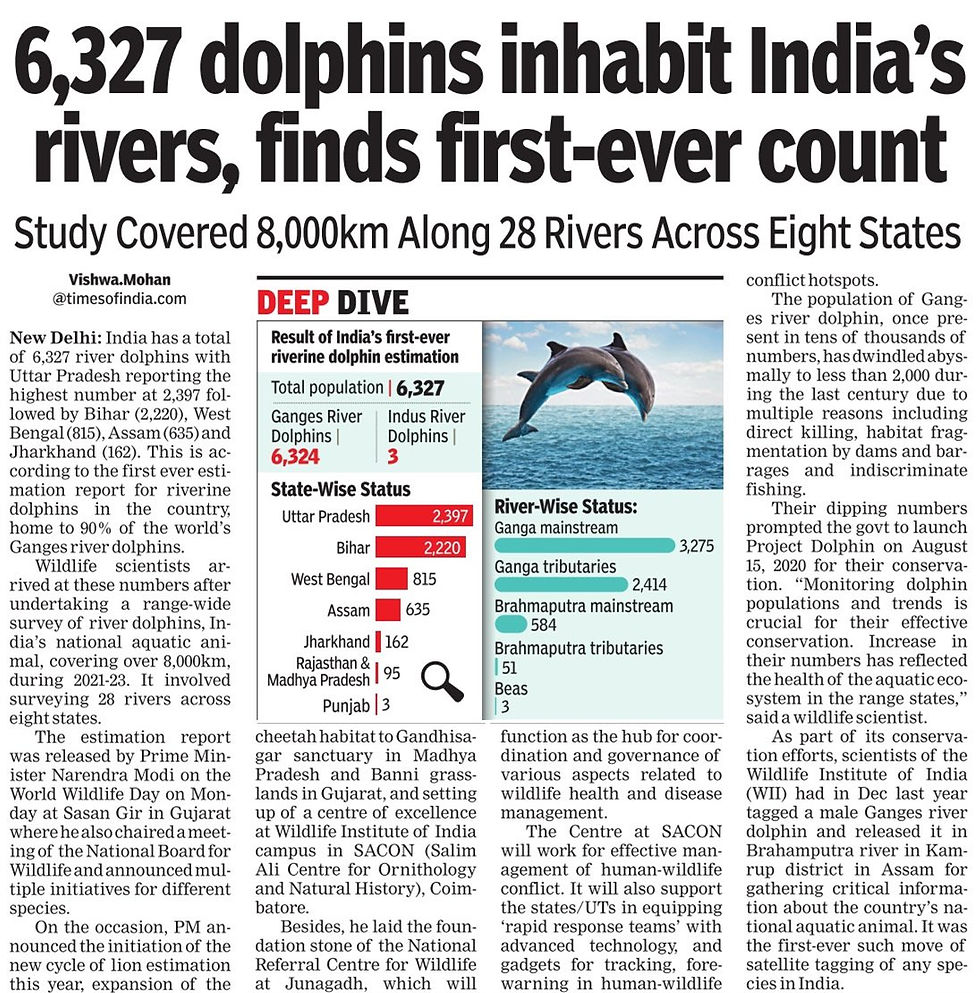
However, its distribution has drastically declined over the past century. Despite its wide range, significant knowledge gaps remain regarding this species due to its elusive behaviour.
It surfaces for only 5-30 seconds at a time, posing a significant challenge in understanding the ecological needs of the species and for any scientifically sound conservation interventions.
5 .Jaipur to host 12th Regional 3R & Circular Economy Forum from March 3-5:(GS Paper II: Governance, Constitution, Polity, Social Justice and International Relations) from March 3rd to 5th, 2025, Jaipur, Rajasthan, will host the 12th Regional 3R & Circular Economy Forum, a pivotal event dedicated to advancing sustainable practices across the Asia-Pacific region.
Held at the Rajasthan International Centre, the forum, themed "Realizing Circular Societies Towards Achieving SDGs and Carbon Neutrality in Asia-Pacific," is organized by the Ministry of Housing and Urban Affairs (India), the United Nations Centre for Regional Development (UNCRD), and the Institute for Global Environmental Strategies (IGES), with support from numerous international organizations.
This gathering will feature discussions on policy, technology, and financing related to the 3Rs (reduce, reuse, recycle) and the broader circular economy, with a dedicated "India Pavilion" showcasing national initiatives.
The forum will culminate in the adoption of the 'Jaipur Declaration' (2025-34), and will also include an international '3R trade and technology exhibition', aiming to foster collaboration and promote innovative solutions for a more sustainable future.
6 .Cyclone Garance.: (General Studies-III (250 marks)Technology, Economic Development, Biodiversity, Environment, Security, and Disaster Management)
Tropical Cyclone Garance delivered a devastating blow to Réunion Island, making landfall on its northern coast and unleashing destructive winds and torrential rainfall. The impact was severe, resulting in reported fatalities, widespread power outages, and significant disruptions to water supplies.
The severity of the cyclone prompted high-level warnings, reflecting the rare occurrence of such direct landfalls on the island. Even as the most intense phase subsided, severe weather conditions persisted, necessitating ongoing vigilance.
Recovery efforts are now underway, focusing on restoring power and water supplies, and providing shelter to those affected, as the storm transitioned into an extratropical cyclone.

Réunion Island, nestled in the Indian Ocean east of Madagascar and southwest of Mauritius, stands as an overseas department and region of France, seamlessly integrating French culture with a breathtaking tropical landscape. This volcanic island boasts a dramatic topography, characterized by towering mountains, including the "active" Piton de la Fournaise and the "extinct" Piton des Neiges, alongside stunning cirques, verdant rainforests, and varied coastlines.
Comments