


Today's Brief 3/10/2024
- Smriti IASxp

- Oct 3, 2024
- 6 min read
Youtube IE : https://youtu.be/No9a1b2-sf4?si=ZOal9-odi6cBrcJr
Youtube JN :https://youtu.be/vgv19Jb47j0?si=sPzjC-Db0lMr07Iy
German Unity Day (Tag der Deutschen Einheit) is celebrated on October 3rd each year. It commemorates the reunification of Germany in 1990, when East Germany (the German Democratic Republic) and West Germany (the Federal Republic of Germany) were officially united after being divided during the Cold War.
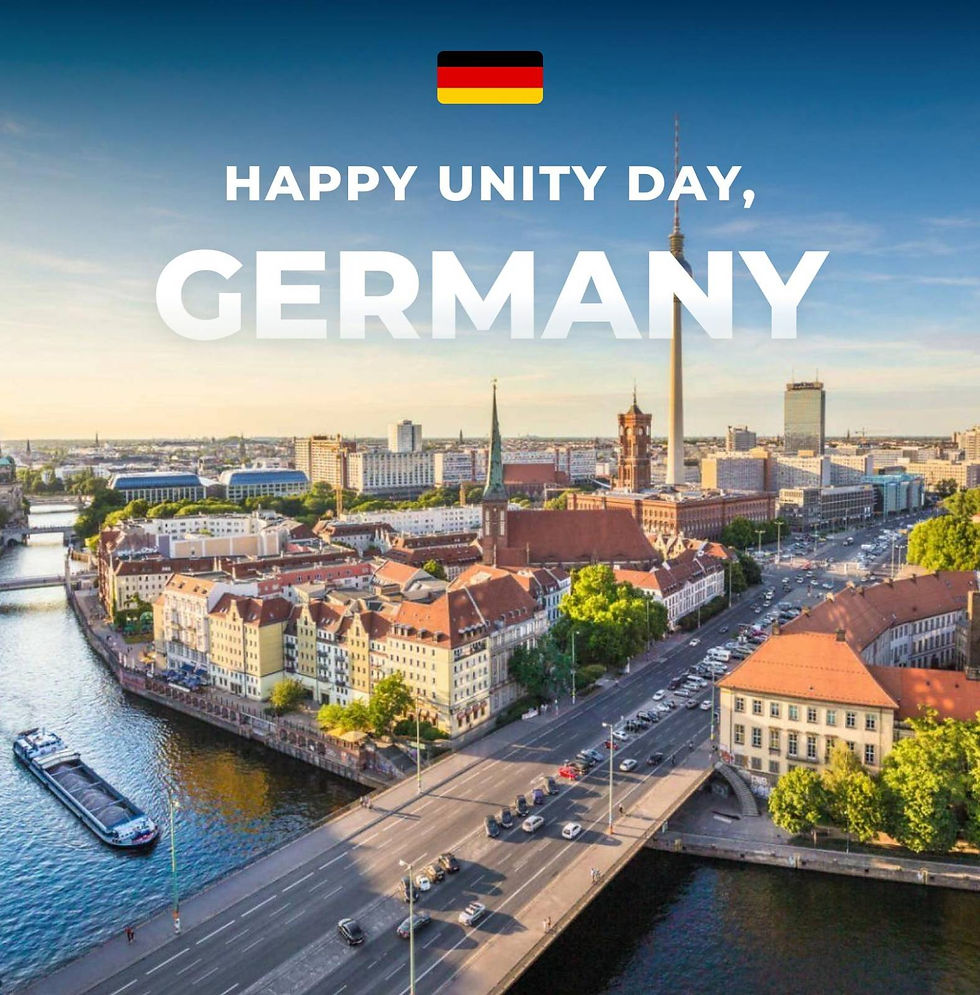
This historic event marked the end of the division of Germany, which began in 1949.
The fall of the Berlin Wall on November 9, 1989, was a major catalyst for reunification. The process of reunification was formalized on October 3, 1990, and this date has since become a national holiday in Germany. It is a day of celebration marked by official ceremonies, cultural events, concerts, and fireworks throughout the country.
Each year, a different German city hosts the national celebration of German Unity Day, featuring a large festival with political speeches and cultural programs.
German Unity Day celebrates the reunification of Germany, a process that culminated on October 3, 1990.
Post-World War II Division (1945): After Germany’s defeat in World War II, the country was divided into four occupation zones controlled by the United States, the Soviet Union, Britain, and France. In 1949, this led to the creation of two separate states:
West Germany (Federal Republic of Germany), influenced by the U.S. and its allies.
East Germany (German Democratic Republic), controlled by the Soviet Union.
The Cold War and Berlin Wall (1961): The ideological and political divide deepened during the Cold War, and in 1961, the East German government built the Berlin Wall to prevent citizens from fleeing to the West. The Wall became a symbol of the Cold War and the separation of East and West.
Reform Movements in Eastern Europe (Late 1980s): By the late 1980s, political reforms were sweeping across Eastern Europe, driven by the Soviet Union's policy of glasnost (openness) and perestroika (restructuring). These reforms sparked protests in East Germany, demanding freedom and democracy.
Fall of the Berlin Wall (November 9, 1989): Mass protests and political changes led to the unexpected opening of the Berlin Wall in November 1989. This event marked the beginning of the end of East Germany’s communist regime and paved the way for reunification.
German Reunification (October 3, 1990): After months of negotiations between the two German states, and with the support of international powers, the Treaty on the Final Settlement (commonly known as the Two Plus Four Agreement) was signed. This allowed for the formal reunification of Germany on October 3, 1990
2.‘Shelved’ Govt Report Points At 20% Decline In Elephant Population In Country In Five-Yr Period: Hundreds of copies of the Environment Ministry’s elephant census report — Status of Elephant in India 2022-23 — have been gathering dust since February this year. The government hasn’t released the report citing a delay in the census in the Northeast.

The data from the unreleased report, reviewed by The Indian Express, shows a 20 per cent drop in the elephant population from five years ago, with the Central Indian and Eastern Ghats even recording an alarming 41 per cent dip compared with 2017 estimates.
Besides recording the dip in the elephant numbers, the unreleased report identifies “mushrooming developmental projects” such as “unmitigated mining and linear infrastructure construction” as significant threats to the species.

3.Psychedelic drugs, also known as hallucinogens, are substances that alter perception, mood, and cognitive processes. They are known for their ability to induce altered states of consciousness, often characterized by visual and auditory hallucinations, changes in thought patterns, and a sense of heightened awareness.
Some of the most well-known psychedelic drugs include LSD (lysergic acid diethylamide), psilocybin (found in certain species of mushrooms), DMT (dimethyltryptamine), and mescaline (found in the peyote cactus).
Key Features of Psychedelics:
Altered Perception: Users may experience vivid visual distortions, altered sense of time, and enhanced sensory experiences.
Hallucinations: These can be visual, auditory, or tactile, ranging from subtle distortions to intense, vivid experiences.
Ego Dissolution: Some users report a feeling of losing their sense of self or merging with their surroundings, often described as a "mystical" or "spiritual" experience.
Emotional Intensity: Psychedelics can amplify emotions, leading to intense joy, fear, or anxiety depending on the user's mental state and environment (often referred to as "set and setting").
History and Use:
Traditional Use: Many indigenous cultures have used psychedelics like psilocybin mushrooms and peyote for centuries in religious and healing ceremonies.
Modern Era (1940s–1970s): In the mid-20th century, psychedelics gained attention in Western medicine and psychology. LSD, in particular, was studied for its potential in treating mental health conditions like depression and anxiety, and was also popularized in the 1960s counterculture.
The War on Drugs: In the 1970s, psychedelics were classified as Schedule I drugs in many countries, including the U.S., due to concerns about their safety and potential for abuse. This greatly restricted research.
Renaissance of Research (2000s–Present): In recent decades, there has been renewed scientific interest in psychedelics for their potential therapeutic effects. Studies have shown promising results in treating conditions like PTSD, depression, anxiety, and addiction.
Common Psychedelic Drugs:
LSD (Acid): Synthesized in 1938, LSD is one of the most powerful psychedelics. It produces profound changes in perception and thought processes, often lasting 8–12 hours.
Psilocybin (Magic Mushrooms): Naturally occurring in certain mushrooms, psilocybin has similar effects to LSD but typically lasts around 4–6 hours. It’s being studied for its therapeutic potential in mental health.
DMT (Dimethyltryptamine): Found in some plants and animals, DMT induces a brief but intensely immersive experience, often lasting less than 30 minutes when smoked or vaporized. It’s a key component of the traditional Amazonian brew, ayahuasca.
Mescaline: Derived from the peyote cactus, mescaline has been used for centuries by Native American tribes in spiritual rituals. It induces vivid visual effects and lasts for about 10–12 hours.
MDMA (Ecstasy): Though technically not a classic psychedelic, MDMA has psychedelic-like effects. It's often classified as an empathogen due to its ability to increase emotional openness and empathy. It's being studied for its use in PTSD treatment.
Therapeutic Potential:
Recent studies suggest psychedelics could have significant potential in treating various mental health disorders, including:
Depression and Anxiety: Especially in cases where traditional treatments have failed, psychedelics like psilocybin have shown promise in alleviating symptoms.
PTSD: MDMA-assisted therapy has shown success in reducing PTSD symptoms.
Addiction: Some studies indicate that psychedelics like psilocybin and LSD may help treat addiction to substances like alcohol and nicotine.
Risks and Challenges:
Bad Trips: Users can experience intense fear, paranoia, or confusion, especially if taken in an uncontrolled or unfamiliar environment.
Psychological Impact: In rare cases, psychedelics can trigger psychosis or exacerbate pre-existing mental health conditions.
Legal Status: Psychedelics are still illegal in many countries, although there’s growing support for decriminalization and therapeutic use in certain jurisdictions.
Psychedelic research continues to expand, with growing recognition of the potential benefits for mental health, balanced by the need for careful regulation and clinical guidance.
Special Campaign 4.0: Ministry of Micro, Small & Medium Enterprises (MSME), Government of India, commences the “Special Campaign 4.0”, a significant initiative aimed at achieving the goals of institutionalizing Swachhata and minimizing pendency across its offices nationwide from 2nd October to 31st October 2024.
This campaign is focused on reinforcing cleanliness and optimizing service delivery across the Ministry’s attached, subordinate and autonomous organizations as well as the field offices.
The “Special Campaign 4.0” comprises of two phases. During the Preparatory Phase carried out from 16th September 2024 to 30th September 2024, the Ministry set specific targets, including the identification of cleanliness campaign sites, planning for space management and office beautification, recognizing scrap and redundant items, and identifying pending references and State-level matters for resolution.
In the Implementation Phase from 2nd October 2024, to 31st October 2024, the Ministry will focus on the execution of the planned activities, ensuring comprehensive coverage of cleanliness efforts and enhancing operational efficiency. The Ministry of MSME has issued necessary directives to all its divisions, statutory bodies, autonomous organizations, and field offices nationwide, to ensure a coordinated effort towards achieving cleanliness of work environment and streamlining service delivery.
As a part of the Campaign, Ministry of MSME has undertaken several key steps to make “Special Campaign 4.0” a success which inter alia, includes the following:
Appointment of Nodal Officers: Nodal Officers have been appointed in offices to coordinate and monitor the Campaign’s activities, ensuring smooth and effective implementation.
Successful Identification of Key Tasks: Various preparatory tasks, such as, identifying cleanliness campaign sites, implementing office beautification, removing redundant materials, and addressing pending references, were executed, contributing to the Campaign's objectives.
Awareness Initiatives: Banners and standees promoting the Campaign have been displayed in Udyog Bhawan and field offices, to raise awareness among employees and stakeholders.
Active Utilization of Social Media Platforms: lnformation about the campaign is being disseminated through social media platforms, for widespread awareness and participation.
Ministry of MSME, in collaboration with its attached and field organisations, underlines its unwavering commitment towards achieving the targets set under “Special Campaign 4.0,” making the initiative a notable success and reaffirming the Ministry's dedication for institutionalizing Swachhata and minimizing pendency across its operations.
EuroNaval 24: India is among 104 countries invited to attend the world's largest naval defence trade show that will be held in Paris from November 4-7. This year, there will be shows on innovative solutions to protect naval forces and maritime infrastructure against air and surface drones

6.Jamaica Marg’: Prime Minister Narendra Modi on Tuesday announced that the road in front of the Jamaica High Commission in New Delhi has been named ‘Jamaica Marg’,
Claudia Sheinbaum was sworn in as Mexico's first woman president

Refrence:
Comments