


Today's Brief 28/12/2024
- Smriti IASxp

- Dec 28, 2024
- 3 min read
IE Analysis: https://youtu.be/nwA1-kGXh88?si=WKdCHVHVmYb0vB_g
JN Analysis: https://youtu.be/04hKDygsiXA?si=uJ172e8hMOfTvY-Z
1 .Panama Canal: is an artificial 82-kilometer (51-mile) waterway in Panama that connects the Atlantic Ocean with the Pacific Ocean. It is a vital conduit for maritime trade, significantly reducing travel time and distance for ships traveling between the two oceans.

2 .Lighthouse Tourism In INDIA:
With a coastline spanning over 7,500 kilometres, India is home to 204 lighthouses that silently guard its rich maritime heritage. Traditionally serving as navigational aids for seafarers, these iconic structures are now being reimagined as tourism destinations under the Government of India’s developmental vision. This initiative aims to preserve the historical and architectural significance of lighthouses and unlock their potential for economic growth and community empowerment.

What is Lighthouse Tourism?
Lighthouse tourism involves transforming lighthouses and their surrounding areas into vibrant tourist attractions. These structures, often located in scenic coastal or island settings, offer visitors a unique combination of natural beauty,
maritime history, and recreational opportunities.
The Central Government is actively promoting lighthouse tourism as a part of its broader Maritime India Vision (MIV) 2030 and Amrit Kaal vision 2047 to enhance India's cultural heritage and maritime legacy.
By developing these sites, the government seeks to enhance India’s tourism offerings while creating employment opportunities and fostering local economic growth.
The Potential of Lighthouse Tourism in India
India’s lighthouses are not merely functional structures but repositories of history and culture. Their potential as tourist destinations stems from several key factors:
Strategic Locations: Many lighthouses are situated in breathtaking locations along India’s coastline or remote islands, offering panoramic sea views.
Cultural Importance: Some lighthouses date back centuries and are near UNESCO World Heritage Sites like Mahabalipuram in Tamil Nadu or other prominent cultural landmarks.
Adventure and Leisure: These sites can host activities such as trekking, boating, and water sports, appealing to adventure seekers.
Economic Impact: Developing lighthouse tourism can generate hospitality, transportation, and handicraft employment while boosting local economies.
Recognising this potential, the government has identified lighthouse tourism as a priority area for development. The initiative aligns with the broader objectives of enhancing India’s global appeal as a travel destination while promoting sustainable tourism practices.
In February 2024, PM Narendra Modi dedicated 75 Lighthouses with tourist facilities in 10 states & UTs.
With an investment of ₹60 crore, these 75 iconic lighthouses have been developed. Each lighthouse has become a beacon of both heritage and recreation, with modern amenities such as museums, amphitheaters, children’s parks, and more. In the fiscal year 2023-24 alone, these 75 dedicated lighthouses attracted an impressive 16 lakh visitors, a rise of more than 400% footfall of tourists from 4 lakhs in 2014. As of September 2024, the current fiscal year 2024-25 has already welcomed more than 10 lakh visitors. More than 500,000 tourists visited the Lighthouses between April and June, 2024, validating the vision of transforming these iconic maritime structures into vibrant tourists hotspots as envisioned by PM Narendra Modi.
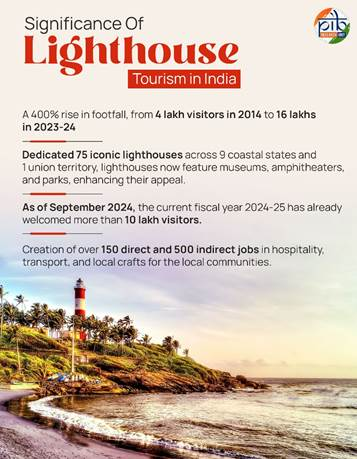
These developments have also resulted in job creation, with 150 direct and 500 indirect employment opportunities emerging in nearby hotels, restaurants, tour operators, transportation services, and local shops and artisans
3.Shock syringe: Researchers at IIT Bombay have developed an innovative shockwave-based syringe that eliminates the need for needles, offering a painless and safer method for drug delivery with minimal skin damage and reduced risk of infection.
Traditional needle injections, while effective, are often associated with fear and discomfort, particularly in children and patients requiring frequent treatments, like those with diabetes. This new device, called the shock syringe, was designed by a team led by Prof. Viren Menezes from the Department of Aerospace Engineering.
Unlike conventional syringes, the shock syringe uses high-energy shock waves—pressure waves traveling faster than sound—to create a microjet of liquid medication that penetrates the skin without piercing it with a sharp tip.
The device, roughly the size of a ballpoint pen, consists of three sections: a driver, a driven section, and a drug holder. Pressurized nitrogen gas generates the shock waves, creating a high-speed liquid jet that delivers the medication quickly and painlessly.
Tests on laboratory rats have demonstrated the shock syringe's effectiveness across various drug types, including anesthetics, antifungals, and insulin. Compared to traditional needles, the device showed similar or better performance in drug absorption, reduced skin damage, and faster healing times.
The shock syringe also minimizes the risk of needle-stick injuries and supports multiple uses, making it cost-effective with proper maintenance.
This breakthrough could revolutionize drug delivery, particularly in immunization campaigns, by ensuring safety, comfort, and efficiency. However, the device's widespread adoption will depend on further advancements, regulatory approval, and affordability to make it accessible for clinical use.
Thanks For Visiting!!
Comments