


Today's Brief 26/02/2025
- Smriti IASxp

- Feb 26, 2025
- 4 min read
IE Analysis:https://youtu.be/t1-P0rG2JRM?si=pYHhpQuQflbG3wOd
JS Analysis:https://youtu.be/e5rolu6ZWhw?si=oC8g8FgtQZVEzsF9
1 .Dharma Guardian:
(General Studies-III (250 marks)Technology, Economic Development, Biodiversity, Environment, Security, and Disaster Management)

is a joint military exercise between India and Japan. It is an annual exercise conducted alternatively .
The exercise aims to enhance interoperability between the two forces while undertaking joint urban warfare and counter-terrorism operations under the UN mandate.
2 .India to host 12th regional 3R and circular economy forum in Jaipur:
(GS Paper II: Governance, Constitution, Polity, Social Justice and International Relations)
Launched by UNCRD in 2009, the Regional 3R and Circular Economy Forum aims to provide strategic policy inputs to government authorities in the Asia-Pacific region for mainstreaming 3R (reduce, reuse, recycle) and circularity and serve as a platform for disseminating and sharing best practices in 3R.
The last Forum was hosted in 2023 by Cambodia. India has previously hosted the Forum in 2018, when the 8th edition was held in Indore.
The 12th Regional Forum is being spearheaded by the Swachh Bharat Mission- Urban of the Ministry of Housing and Urban Affairs in collaboration with Japan’s Ministry of the Environment, UN ESCAP, UNCRD, UNDSDG, and UNDESA, with support from the Government of Rajasthan.
This Forum, focused on the Asia-Pacific region, aims to guide member-countries in shaping policies and actions on 3R and the circular economy in the coming years. With participation expected from 38 invited member countries, 15-line ministries of the Government of India, almost all States/UTs, over 60 cities, more than 40 start-ups and businesses, and around 120 speakers across 3 days,
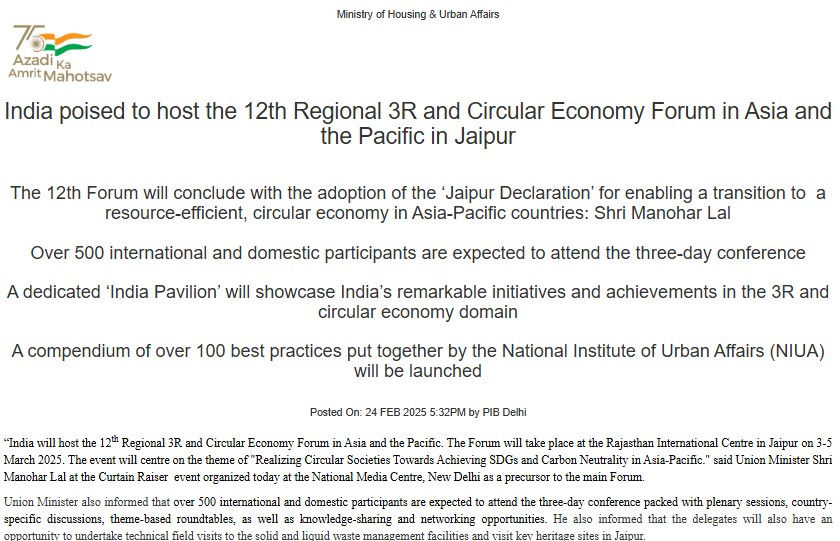
this Forum will serve as a platform for policy discussions, collaboration and knowledge exchange.
By fostering these partnerships, it will accelerate progress towards a circular economy and the achievement of the Sustainable Development Goals (SDGs).
3 .Jhumoir Binandini:
(GS Paper I: Indian Heritage & Culture, History (Modern India, Freedom Struggle, Post-Independence, World), Geography (World, Resources, Industries), and Society (Indian, Women, Population, Empowerment, Globalization).
a monumental cultural event, took place in Guwahati, Assam, on February 24, 2025.
This spectacular event showcased the vibrant Jhumur dance, a traditional folk dance of the tea tribe and Adivasi communities of Assam. Around 8,000 artists participated, creating a record-breaking spectacle that celebrated the rich cultural heritage of these communities, who possess a unique identity and history.
The event also served as a commemoration of 200 years of the tea industry in Assam, acknowledging the significant contributions of the tea tribes. The presence of Prime Minister Narendra Modi, along with other dignitaries, brought national attention to the Jhumur dance and the tea tribe community, further emphasizing the importance of this cultural celebration.
4 . Innovate with GoIStats: (GS Paper II: Governance, Constitution, Polity, Social Justice and International Relations)
(General Studies-III (250 marks)Technology, Economic Development, Biodiversity, Environment, Security, and Disaster Management)
The Ministry of Statistics and Programme Implementation (MoSPI), in collaboration with MyGov, is set to launch an exciting data-visualization hackathon titled "Innovate with GoIStats", centered around the theme “Data-Driven Insights for Viksit Bharat”.
The hackathon aims to inspire India’s young and brightest minds – students and researchers to utilize the vast official statistics generated by the National Statistics Office (NSO) for creating innovative data driven insights.
The hackathon will invite participants to explore and analyse official statistics from the reports, microdata and other datasets available on the website of the Ministry, such as the Periodic Labour Force Survey (PLFS), Household Consumer Expenditure Survey (HCES), Annual Survey of Industries (ASI), Consumer Price Index (CPI), Gross Domestic Product (GDP) and more to create impactful visualizations to support evidence-based policymaking in the journey towards Viksit Bharat.
Participants can gain hands-on experience with official statistics while creating a stronger foundation for data-driven policy insights.

The Hackathon will take place on the MyGov platform, from 25th February 2025 to 31st March 2025. Students pursuing undergraduate, postgraduate or doing research can participate.
The top 30 entries, selected by a panel of expert evaluators from the industry and academia will get prize money, with one first prize of ₹2 Lakhs, followed by two second prizes of ₹1 Lakh each, two third prizes of ₹50,000 each and twenty-five consolation prizes of ₹20,000 each.
5 .PM Surya Ghar Muft Bijli Yojana: (GS Paper II: Governance, Constitution, Polity, Social Justice and International Relations)
(General Studies-III (250 marks)Technology, Economic Development, Biodiversity, Environment, Security, and Disaster Management)
The Government of India has approved the scheme on 29th February, 2024 to increase the share of solar rooftop capacity and empower residential households to generate their own electricity.
The scheme has an outlay of Rs 75,021 crore and is to be implemented till FY 2026-27. The scheme will be implemented by a National programme Implementation Agency (NPIA) at the National level and by the State Implementation Agencies (SIAs) at the state level.
The Distribution Utility (DISCOMs or Power/Energy Departments, as the case may be) shall be the State Implementation Agencies (SIA) at the State/UT level.
c) Under the scheme, the DISCOMs shall be required to put in place several facilitative measures for promotion of rooftop solar in their respective areas such as availability of net meters, timely inspection and commissioning of installations, vendor registration and management, interdepartmental convergence for solarizing government building etc.

How does PM Surya Ghar Muft Bijlee Yojana work?
The scheme provides for a subsidy of 60% of the solar unit cost for systems up to 2kW capacity and 40 percent of additional system cost for systems between 2 to 3kW capacity. The subsidy has been capped at 3kW capacity.
At current benchmark prices, this will mean Rs 30,000 subsidy for 1kW system, Rs 60,000 for 2kW systems and Rs 78,000 for 3kW systems or higher.

Who are eligible to apply for the Scheme?
The applicant must be an Indian citizen.
Must own a house with a roof that is suitable for installing solar panels.
The household must have a valid electricity connection.
The household must not have availed of any other subsidy for solar panels.
Thanks For Visiting!!
Comments