


Today's Brief 13/09/2024
- Smriti IASxp

- Sep 13, 2024
- 5 min read
Youtube English:https://youtu.be/Qm2DjSxf2UI?feature=shared
Youtube Hindi:
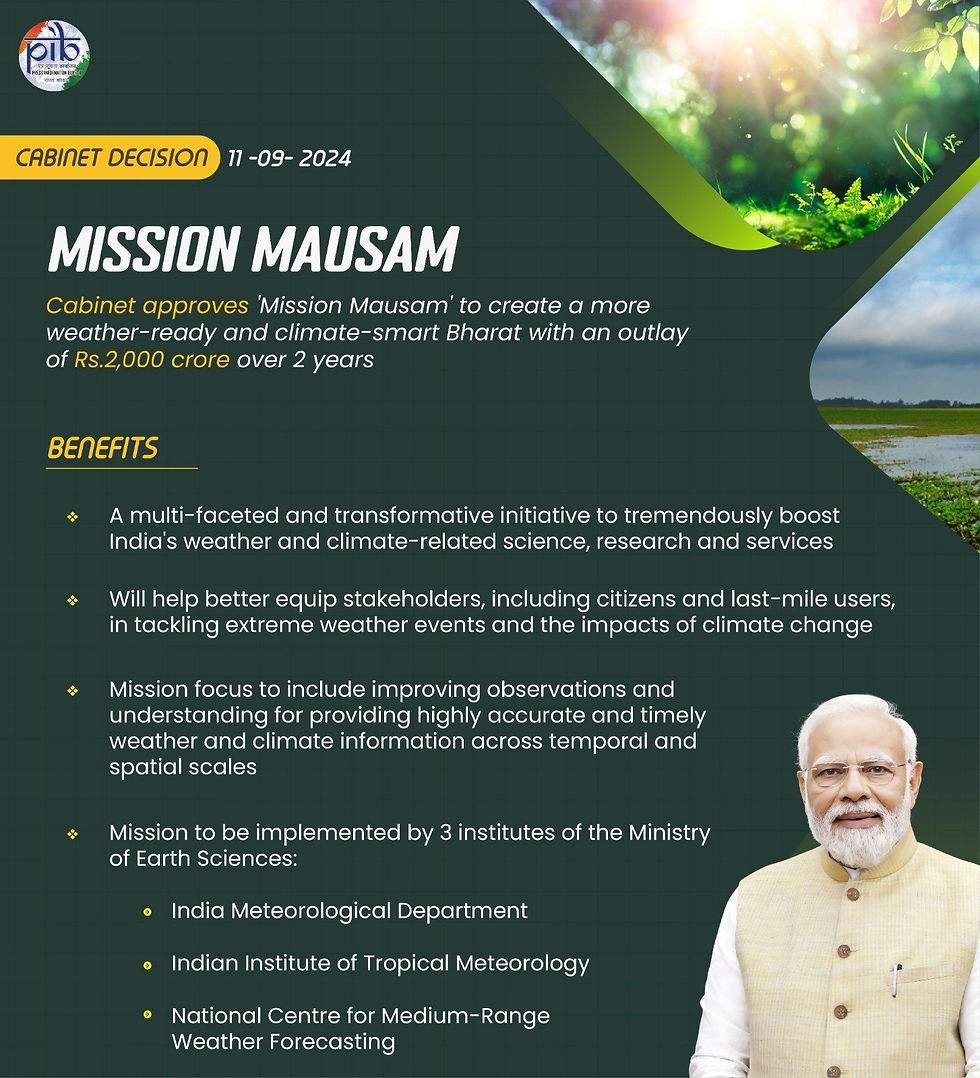
Mission Mausam: Mission Mausam, to be chiefly implemented by the Ministry of Earth Sciences, is envisaged to be a multi-faceted and transformative initiative to tremendously boost India's weather and climate-related science, research, and services.
It will help to better equip stakeholders, including citizens and last-mile users, in tackling extreme weather events and the impacts of climate change. The ambitious program will help broaden capacity and resilience across communities, sectors, and ecosystems in the long run.
As part of the Mission Mausam, India will exponentially expound research and development, and capacity in atmospheric sciences, especially weather surveillance, modelling, forecasting, and management. By integrating advanced observation systems, high-performance computing, and cutting-edge technologies like artificial intelligence and machine learning, Mission Mausam will set a new benchmark for predicting weather with high precision.
The mission's focus will include improving observations and understanding for providing highly accurate and timely weather and climate information across temporal and spatial scales, including monsoon forecasts, alerts for air quality, extreme weather events and cyclones, weather interventions for managing fog, hail, and rain, etc., capacity building and generating awareness.
Critical elements of Mission Mausam will include the deployment of next-generation radars and satellite systems with advanced sensors and high-performance supercomputers, the development of improved Earth system models and a GIS-based automated Decision Support System for real-time data dissemination.
Mission Mausam will directly benefit numerous sectors, such as agriculture, disaster management, defence, environment, aviation, water resources, power, tourism, shipping, transport, energy, and health. It would also enhance data-driven decision making in areas such as urban planning, road and rail transport, offshore operations, and environmental monitoring.
Three institutes of the Ministry of Earth Sciences: the India Meteorological Department, the Indian Institute of Tropical Meteorology, and the National Centre for Medium-Range Weather Forecasting will primarily implement Mission Mausam.
These institutions will be supported by other MoES institutions (Indian National Centre for Ocean Information Services, National Centre for Polar and Ocean Research, and National Institute of Ocean Technology), along with collaborating national and international Institutes, Academia and Industries, furthering India's leadership in weather and climate sciences and services.
2.National Florence Nightingale Award: The award is given to outstanding nursing personnel employed in Central, State/UTs and Voluntary Organizations. The nurse in her/his regular job in the hospital or community settings, educational or administrative setting is eligible for the national award
The National Florence Nightingale Award was instituted by the Ministry of Health and Family Welfare in the year 1973. This award is given as a mark of recognition for the meritorious services rendered by the nurses and nursing professionals to society.
3. PM E-DRIVE Scheme: The Union Cabinet chaired by the Prime Minister Shri Narendra Modi, has approved the proposal of Ministry of Heavy Industries (MHI) for implementation of scheme titled ‘PM Electric Drive Revolution in Innovative Vehicle Enhancement (PM E-DRIVE) Scheme’ for promotion of electric mobility in the country.
The scheme has an outlay of Rs 10,900 crore over a period of two years.
The major components of the scheme are as under:
Subsidies/Demand incentives worth Rs.3,679 crore have been provided to incentivize e-2Ws, e-3Ws, e-ambulances, e-trucks and other emerging EVs. The scheme will support 24.79 lakh e-2Ws, 3.16 lakh e-3Ws, and 14,028 e-buses.
MHI is introducing e-vouchers for EV buyers to avail demand incentives under the scheme. At the time of purchase of the EV, the scheme portal will generate an Aadhaar authenticated e-Voucher for the buyer. A link to download the e- voucher shall be sent to the registered mobile number of the buyer.
This e-voucher will be signed by the buyer and submitted to the dealer to avail demand incentives under the scheme. Thereafter, the e-Voucher will also be signed by the dealer and uploaded on the PM E-DRIVE portal. The signed e-voucher shall be sent to the buyer and dealer through an SMS. The signed e-voucher will be essential for OEM to claim reimbursement of demand incentives under the scheme.
The scheme allocates Rs.500 crore for the deployment of e-ambulances. This is a new initiative of Govt of India to promote the use of e-ambulance for a comfortable patient transport. The performance and safety standards of e-ambulances will be formulated in consultation with MoHFW, MoRTH and other relevant stakeholders.
A sum of Rs.4,391 crore has been provided for procurement of 14,028 e-buses by STUs/public transport agencies. The demand aggregation will be done by CESL in the nine cities with more than 40 lakh population namely Delhi, Mumbai, Kolkata, Chennai, Ahmedabad, Surat, Bangalore, Pune and Hyderabad. Intercity and Interstate e-buses will also be supported in consultation with states.
While allocating buses to cities/states, first preference shall be given to those number of buses of cities/states, which are being procured after scrapping old STU buses, through authorised scrapping centres (RVSFs) following the MoRTH Vehicle Scrapping Scheme guidelines.
The trucks are a major contributor to air pollution. The scheme will promote the deployment of e-trucks in the country. Rs.500 crore has been allocated for incentivising e-trucks. Incentives will be given to those who have a scrapping certificate from MoRTH approved vehicles scrapping centres (RVSF).
The scheme addresses range anxiety of EV buyers by promoting in a big way the installation of electric vehicle public charging stations (EVPCS). These EVPCS shall be installed in the selected cities with high EV penetration and also on selected highways. The scheme proposes the installation of 22,100 fast chargers for e-4 Ws, 1800 fast chargers for e-buses and 48,400 fast chargers for e-2W/3Ws. The outlay for EV PCS will be Rs.2,000 crore.
In view of the growing EV ecosystem in the country, the test agencies of MHI will be modernized to deal with the new and emerging technologies to promote green mobility. The upgradation of testing agencies with an outlay of Rs.780 crore under the aegis of MHI has been approved.
The scheme promotes mass mobility by supporting means of public transportation. The primary objective of the PM E-DRIVE scheme is to expedite the adoption of EVs by providing upfront incentives for their purchase, as well as by facilitating the establishment of essential charging infrastructure for EVs. The PM E-DRIVE scheme aims to promote EVs to reduce the environmental impact of transportation and improve air quality.

The scheme promotes an efficient, competitive and resilient EV manufacturing industry thereby promoting Aatmanirbhar Bharat. This will be achieved by incorporating phased manufacturing programme (PMP) which encourages domestic manufacturing and strengthening of EV supply chain.
This initiative of Govt. of India is poised to address concerns regarding environmental pollution and fuel security as well as to make significant progress in promoting sustainable transportation solutions. This scheme along with its PMP, shall spur investment in the EV sector and associated supply chain. The scheme shall create significant employment opportunities along the value chain. There will also be employment generation through manufacturing and establishment of charging infrastructure
Thanks for Visiting!!
Source: PIB, DDNews , AIR
Comments