


Today's Brief 1-3/12/2024
- Smriti IASxp

- Dec 4, 2024
- 5 min read
IE Analysis: https://youtu.be/wzGuSFU4xr4?si=VzTxdv0aovQ391Qt
JN Analysis: https://youtu.be/VG7PHqt0HeA?si=MBd7B2_qASLSrei8
1 .The International Day of Persons with Disabilities (IDPD)
General Studies - II (Governance, Constitution, Polity, Social Justice and International relations)
is observed annually on December 3rd. The theme for 2024 is "Amplifying the leadership of persons with disabilities for an inclusive and sustainable future."
This theme recognizes the importance of disability rights and the need to empower individuals with disabilities to take on leadership roles in society. It emphasizes the need for inclusive and sustainable development that considers the needs and perspectives of persons with disabilities.

The International Day of Persons with Disabilities (IDPD) was established by the United Nations General Assembly in 1992. It's observed annually on December 3rd to promote the rights and well-being of individuals with disabilities.
india has made significant strides in promoting the rights and inclusion of Divyangjan through various policies and campaigns. A few of these initiatives are listed below:
Department of Empowerment of Persons with Disabilities
In order to give focused attention to policy issues and meaningful thrust to the activities aimed at the welfare and empowerment of Persons with Disabilities (PwDs), a separate Department of Disability Affairs was carved out of the Ministry of Social Justice and Empowerment on May 12, 2012. The Department was renamed the Department of Empowerment of Persons with Disabilities on December 8, 2014.
The Department acts as a nodal agency for matters pertaining to disability and persons with disabilities, including effecting closer coordination among different stakeholders: related Central Ministries, State/UT Governments, NGOs, etc., in matters pertaining to disability.
Accessible India Campaign
The Accessible India Campaign (Sugamya Bharat Abhiyan), launched on December 3, 2015 aims to achieve universal accessibility for Persons with Disabilities (PwDs) across India.The key focus areas include improving Built Environment Accessibility in public spaces, enhancing Transportation Accessibility for independent mobility, creating an accessible Information and Communication ecosystem, and expanding Sign Language Access through interpreter training and better media support.
Deendayal Divyangjan Rehabilitation Scheme (DDRS)
DDRS is a central sector scheme to provide grant-in-aid to non-governmental organizations (NGOs) for projects relating to the rehabilitation of persons with disabilities aimed at enabling persons with disabilities to reach and maintain their optimal, physical, sensory, intellectual, psychiatric, or socio-functional levels. The scheme aims to create an enabling environment to ensure equal opportunities, equity, social justice, and empowerment of persons with disabilities and to encourage voluntary action to ensure effective implementation of the Rights of Persons with Disabilities Act, 2016.
District Disability Rehabilitation Centre (DDRC)
The District Disability Rehabilitation Centre (DDRC) aims to address the needs of persons with disabilities through a multifaceted approach. Its objectives include early identification and intervention, raising awareness, and assessing the need for assistive devices along with their provision and fitment, arrangement of loans for self-employment and more. Additionally, it acts as an outreach center for services provided by National Institutes and works to promote a barrier-free environment for individuals with disabilities.
Assistance to Persons with Disabilities for Purchase/Fitting of Aids/ Appliances (ADIP) Scheme.
The main objective of the Scheme is to provide grants-in-aid to the various implementing agencies (National Institutes/Composite Regional Centers/Artificial Limbs Manufacturing Corporation of India. (ALIMCO)/District Disability Rehabilitation Centers/State Handicapped Development Corporations/ other Local Bodies/NGOs) so that they are in a position to assist needy persons with disabilities in procuring durable, sophisticated and scientifically manufactured, modern, standard aids and appliances to promote their physical, social and psychological rehabilitation by reducing the effects of disabilities and at the same time enhancing their economic potential.
2 .ONOS: The initiative will open a goldmine of knowledge available in top quality scholarly journals to nearly 1.8 crore students, faculty, researchers and scientists of all disciplines, including those in tier 2 and tier 3 cities, thereby encouraging core as well as interdisciplinary research in the country A total of 30 major international journal publishers have been included in One Nation One Subscription.
All of the nearly 13,000 e-journals published by these publishers will now be accessible to more than 6,300 government Higher Education Institutions and central government R&D institutions
Access to journals will be provided through a national subscription coordinated by the Information and Library Network (INFLIBNET), an autonomous interuniversity centre of the University Grants Commission (UGC) through an entirely digital process A total of almost 6,000 crore has been allocated for One Nation One Subscription for 3 calendar years, 2025, 2026 and 2027 as a new Central Sector Scheme
3 .South Korea:
General Studies - II (Governance, Constitution, Polity, Social Justice and International relations)
President Yoon Suk Yeol’s cabinet has reversed a martial law order in the country, just hours after he issued the surprise decree that plunged Seoul into political uncertainty and sparked fierce backlash from lawmakers across the political spectrum.
The cabinet decision came after Yoon backtracked on his shortlived decree in the early hours of Wednesday local time and withdrew the troops deployed to carry out the order.
South Korean lawmakers – who had scrambled earlier in the night to block the martial law order with a parliamentary vote – are now calling for resignations.
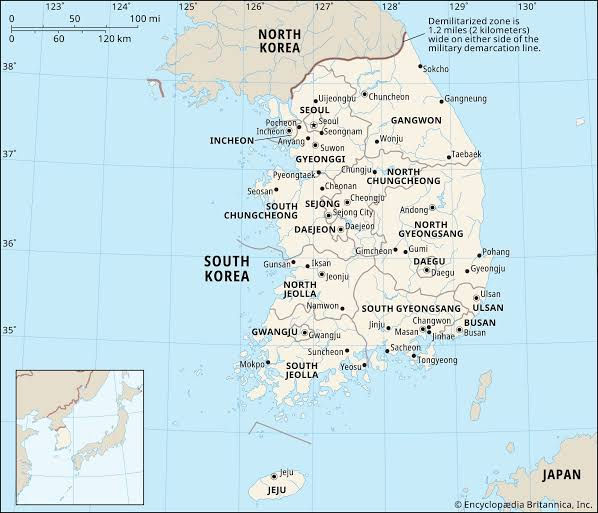
Situated in Northeast Asia, the Korean Peninsula shares borders with China, Russia, and Japan. Its geographical coordinates range between 33° and 43°N latitude and 124° and 132°E longitude. The peninsula spans approximately 1,000 km in length and 300 km in width, with a total land area of 222,000 km², of which South Korea occupies around 100,364 km². Notably, about three-quarters of the land is mountainous, with higher altitudes concentrated in the northern and eastern regions, where steep mountain ranges dominate the landscape.

The eastern coastline is marked by deep waters and straightforward shores, while the western and southern coasts are characterized by shallower seas, intricate coastlines, and numerous islands.
ClimateSouth Korea experiences a temperate climate with four distinct seasons. Spring and autumn are sunny and dry due to migratory anticyclones, while summer brings hot, humid conditions influenced by the North Pacific anticyclone. Winters are cold and dry, dominated by a northern continental anticyclone.
Annual temperatures vary between 7°C and 15°C, with January being the coldest month (-6.9°C to 3.6°C) and August the warmest (19.7°C to 26.7°C). Precipitation averages 1,300 mm annually, with over half occurring in the summer, particularly during the monsoon season (jangma) in July and August. Recent trends indicate a gradual shift toward subtropical conditions, with tropical crops like bananas becoming more common.
PopulationAs of 2022, South Korea’s population is approximately 51.63 million, ranking it 29th globally. Over half of the population resides in the Seoul Capital Area, highlighting regional disparities. Life expectancy has significantly increased from 62.3 years in 1970 to 83.6 years in 2021, driven by advancements in healthcare and economic growth. However, the country faces challenges related to its declining birth rate and aging population.
Language and Cultural SymbolsThe Korean language and its unique writing system, Hangeul, were devised by King Sejong during the Joseon Dynasty in 1443. Recognized for its scientific design, Hangeul is praised globally for its simplicity and efficiency.
It remains the only writing system inscribed on UNESCO’s Memory of the World Register. South Korea’s national symbols include the Taegeukgi flag, representing balance and harmony, and the Mugunghwa flower, symbolizing resilience.
The national anthem, Aegukga, embodies the country’s patriotic spirit.
Political SystemSouth Korea operates as a democratic republic with a presidential system.
The government consists of three branches: legislative, executive, and judicial.
The President, elected for a single five-year term, oversees the administration. In 2022, Yoon Suk Yeol became the 20th President of the Republic of Korea.
Comments